
Install the app
How to install the app on iOS
Follow along with the video below to see how to install our site as a web app on your home screen.
Note: This feature may not be available in some browsers.
-
After 15+ years, we've made a big change: Android Forums is now Early Bird Club. Learn more here.
You are using an out of date browser. It may not display this or other websites correctly.
You should upgrade or use an alternative browser.
You should upgrade or use an alternative browser.
Any 1 have any soldering experince?
- Thread starter Spec-Kie
- Start date
SiempreTuna
Android Expert
A little, but it was years ago when electronics were way bigger and way less complex
No - only indoors
:rofl:
in various fields?
No - only indoors
:rofl:

Spec-Kie
Well-Known Member
Excellent i wonder if you could help me a little bit? When it comes to soldeing in various mobiles phones what type of flux should i be using ? Any or is there a specific one? Also whats the best type of wire size ? For mobile phone bypassing?
Spec-Kie
Well-Known Member
A little, but it was years ago when electronics were way bigger and way less complex
No - only indoors
:rofl:
Haha i full on walked into that 1 like didnt i haha.

Yes. Cheapo Made in Hong Kong electronics products in the 1980s.
Mikedt. Can you help me if im starting oit doing some.soldering to mobile phones i have a 30w soldering iron fine poiint what flux do i need to use?
What I was doing was 30+ years ago, when components were still large, could hold them in your hands and and didn't need a microscope. LOL.
What I was working on looked rather like this...

This is a transistor radio. Back when radios actually did have real discrete transistors(the black round components)....and components had wire connections, that you just poked through holes in the board.
If you're talking about soldering and repairing mobile phones, this is modern service mount technology SMT stuff with multilayer printed boards, and tiny microscopic chip components.
We used what's called multicore solder, and the rosin flux was already in the solder wire. Didn't need separate flux. Along with a 30-40W temperature controlled fine point iron. But I'd say that might not be suitable for modern SMT as used in cellphones, PCs, DVD players, etc. or any modern consumer electronics for that matter.
AFAIK SMT is done using hot air or wave soldered during manufacture. I've heard of people using toaster ovens, for DIY repair and construction of modern SMT. There's probably a howto somewhere on the interwebs.
This is the board from an iPhone 5....quite a lot different to my 1970s, 1980s Hong Kong transistor radios and cassette players...LOL

What kind of repairs are you trying to do?
Go back 50 years ago+, and it was all vacuum tubes/valves, with large hefty components and high voltages.
Myself I can troubleshoot and work on old vacuum tube/valve and transistor stuff no problem, but that iPhone 5 board, I wouldn't have a clue how to attempt repairs on that. I think Apple would just replace the whole thing and not even attempt repairs.
Spec-Kie
Well-Known Member
Hi mike thanks for the quick reply. Yeah it looks totally different eh and mainly i do battery connector bypass repairs and also backlight ic and lcd connector repairs. So i no that i use hot hair to remove certain components but i no that the solder wire that i have is flux centred but i know that the flux applyed beforehand to the solder pads will prevent bridging  .. its and it helps the solder to attract to the pads and tur component. On ebay there is tonnes of different solder soo i just thought i would ask first before i would order any thing. Cheers
.. its and it helps the solder to attract to the pads and tur component. On ebay there is tonnes of different solder soo i just thought i would ask first before i would order any thing. CheersFor most modern phones as you've already seen your average soldering iron probably won't be of much use. You need really tiny tips for the simple connectors like battery leads and such (assuming soldering to the board, you don't solder to battery cells, those are spot welded).
You really should have a variable temperature, even 30w can be too much, ideally one of the feedback temperature controlled.
Many of the other connectors for lcd and such will be smd where you need custom smd tips and/or heat gun as mentioned.
You need to find the .uk equivalent of digikey or mouser (IIRC maplin or malpin is one electronics catalog over there), your average ebay soldering iron isn't going to do it.
You really should have a variable temperature, even 30w can be too much, ideally one of the feedback temperature controlled.
Many of the other connectors for lcd and such will be smd where you need custom smd tips and/or heat gun as mentioned.
You need to find the .uk equivalent of digikey or mouser (IIRC maplin or malpin is one electronics catalog over there), your average ebay soldering iron isn't going to do it.
Spec-Kie
Well-Known Member
Hey mate yeah your are right no good having a regular SI but i have been looking and would this surfice?
http://m.ebay.co.uk/itm/310770402991?nav=SEARCH&sbk=1
http://m.ebay.co.uk/itm/310770402991?nav=SEARCH&sbk=1

Bob Maxey
Android Expert
Alright guys.
Any one here can help me please. I need a soldering station for smd and rework but im a novice my buget is about
Spec-Kie
Well-Known Member
See i do some mobile phone laptop tablet and pc hardware repair ya see and im planning on taking it to new level. Like replacing ics, connectors and other tiny things on mother boards sorry if i come across arrogant im sti new to this thats why i want to learn .. i have upped my budget to around 90 the volume really at first will not be much so if this helps. Could yiu give me some.examples
.. i have upped my budget to around 90 the volume really at first will not be much so if this helps. Could yiu give me some.examples
Bob Maxey
Android Expert
See i do some mobile phone laptop tablet and pc hardware repair ya see and im planning on taking it to new level. Like replacing ics, connectors and other tiny things on mother boards sorry if i come across arrogant im sti new to this thats why i want to learn
Several things:
1) you need schematics and trouble shooting experience. A service guide might be tricky. I have seen more than ne good rework tech brought to his knees by not understanding the circuit.
2) you need to be able to trouble shoot at the component level. how do you know a chip is bad? You need a good scope.
3) A good solder station is needed. What might be your volume?
4) ESD equipment, 'nuff said.
Luck to ya.
Bob Maxey
Android Expert
What kind of repairs are you trying to do?
Go back 50 years ago+, and it was all vacuum tubes/valves, with large hefty components and high voltages.
Myself I can troubleshoot and work on old vacuum tube/valve and transistor stuff no problem, but that iPhone 5 board, I wouldn't have a clue how to attempt repairs on that. I think Apple would just replace the whole thing and not even attempt repairs.
Cant really tell from the color outlines, but my guess is some of those components could be Ball Grid Array (BGA) packages and that is beyond a hundred dollar soldering station. The connections are made using small balls of solder you cannot easily get to.
Google Ball Grid Array and have a look see.
Can you get replacement parts?
Spec-Kie
Well-Known Member
Hi mate. The main repairs that i do are the battery connector by pass which i have seen a tutorial on and its just bypassing the solder pad as its not there any more .. the other type of repairs i would do are things like lcd connector replacement. Ipod flex cable replacemment and then hopefully in the future get on to replacement on backlight ics and others. I have decided to buy a solder station from maplin 40.00 reduce from 69.00 and the atten hot rework for various ther thing too .
Since you already do work on pc's and laptops start there. I've repaired many laptops by soldering on a new power plug. Those are usually through hole and a little bigger so a $50 soldering iron can do if your careful. The connectors can all be found in electronics catalogs (digikey/mouser).
Next most common is the lcd backlight in laptops and lcd monitors. Newer ones are LED but older ones use a fluorescent tube. Typically the tube just gets old and you can measure and match up a replacement for about $10 in parts. Sometimes the inverter powering them goes so you can replace those as well. You'll find there are not too many combinations of parts as there are less than a half dozen makers of the panels and and standard sizes. A 15" samsung LCD in a dell laptop will use the same tube as a 15" Toshiba LCD in a Toshiba laptop.
Next most common is the lcd backlight in laptops and lcd monitors. Newer ones are LED but older ones use a fluorescent tube. Typically the tube just gets old and you can measure and match up a replacement for about $10 in parts. Sometimes the inverter powering them goes so you can replace those as well. You'll find there are not too many combinations of parts as there are less than a half dozen makers of the panels and and standard sizes. A 15" samsung LCD in a dell laptop will use the same tube as a 15" Toshiba LCD in a Toshiba laptop.
I'm happy to see that at least some modern electronics remains easy to understand and follow.
The humble electronic fluorescent light ballast. Real wire ended components, no surface mount and BGA chips here.
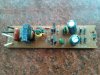
...but then it doesn't actually do much, just starts and runs a florescent light.
This one is from my living room ceiling light and doesn't work. I did actually find what was wrong with it, one transistor was completely open circuit. But not worth repairing, other than to say "Yes I fixed it!", easier and cheaper just to buy a whole new ballast locally, than it is to find the required transistor on-line and order it.
The humble electronic fluorescent light ballast. Real wire ended components, no surface mount and BGA chips here.
...but then it doesn't actually do much, just starts and runs a florescent light.
This one is from my living room ceiling light and doesn't work. I did actually find what was wrong with it, one transistor was completely open circuit. But not worth repairing, other than to say "Yes I fixed it!", easier and cheaper just to buy a whole new ballast locally, than it is to find the required transistor on-line and order it.
Cant really tell from the color outlines, but my guess is some of those components could be Ball Grid Array (BGA) packages and that is beyond a hundred dollar soldering station. The connections are made using small balls of solder you cannot easily get to.
Google Ball Grid Array and have a look see.
Can you get replacement parts?
Not for an Apple A6 processor you can't, not unless you got another scrap/donor iPhone 5, that's proprietary to Apple. Any components with the Apple logo are going to be proprietary. Some of the other things like flash chips should be generic though, as well as all the discrete components, like diodes, capacitors and resistors. It would probably be the same for other phone and tablet manufacturers as well, like Samsung, etc, certain components like processors are going to be proprietary and unavailable. Other things is how do you troubleshoot and fault-find as something as complex as an iPhone 5 mainboard, especially in the absence of a schematic or service manual. It's not quite like an AM transistor radio or electronic light ballast...LOL
BTW I only picked the iPhone as an example, because it was the first clearest picture of a phone's mainboard that came up.
I know where domestic electronics repair might be possible and still economic. Electronic washing machine programmers. Complete replacements from manufacturers can be horribly expensive, often almost as much as a new washing machine. But the faults you might see could be relatively simple, bad solder joints, blown diodes, corrosion as long as it's not too extensive. etc.
Bob Maxey
Android Expert
Not for an Apple A6 processor you can't, not unless you got another scrap/donor iPhone 5, that's proprietary to Apple. Any components with the Apple logo are going to be proprietary. Some of the other things like flash chips should be generic though, as well as all the discrete components, like diodes, capacitors and resistors. It would probably be the same for other phone and tablet manufacturers as well, like Samsung, etc, certain components like processors are going to be proprietary and unavailable. Other things is how do you troubleshoot and fault-find as something as complex as an iPhone 5 mainboard, especially in the absence of a schematic or service manual. It's not quite like an AM transistor radio or electronic light ballast...LOL
BTW I only picked the iPhone as an example, because it was the first clearest picture of a phone's mainboard that came up.
I know where domestic electronics repair might be possible and still economic. Electronic washing machine programmers. Complete replacements from manufacturers can be horribly expensive, often almost as much as a new washing machine. But the faults you might see could be relatively simple, bad solder joints, blown diodes, corrosion as long as it's not too extensive. etc.
when my dear departed father repaired telephone equipment, he learned of a law that (at the time) required manufacturers tio supply parts and repair manuals to anyone who wants one. My guess is Apple will fight you, but then again, if the old laws still exist, they must sell parts to you.
We had to sell Phone-Mate microprocessors and manuals to a local repair concern after they went to Phone-Mate and complained.
when my dear departed father repaired telephone equipment, he learned of a law that (at the time) required manufacturers tio supply parts and repair manuals to anyone who wants one. My guess is Apple will fight you, but then again, if the old laws still exist, they must sell parts to you.
Apple is well known for fighting anyone and everyone and will certainly fight to release any information law or not. You'll need deep pockets and a good lawyer to get any information from them.
Thought i would post in this k e instead of making a new thread. Any one have ne idea on how i could power leds in my laptol casing?
Easiest way would be to buy some '5v LEDs' . LED's don't use 5v but there are many now available with a resistor already built in to work off a common voltage such as 5v, 12v, etc. You can get to a 5v supply on a port such as USB.