• After 15+ years, we've made a big change: Android Forums is now Early Bird Club. Learn more here.

Android Fragmentation Visualized in an Infographic

ashish04

Newbie
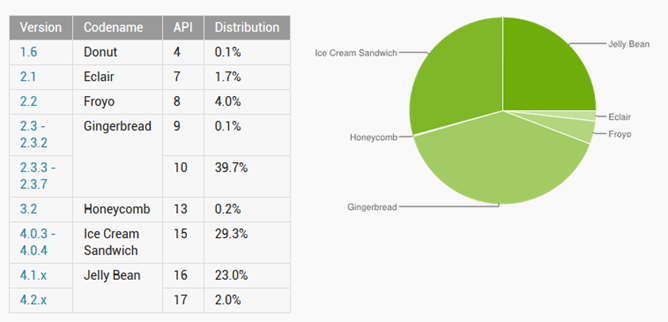
Today in the morning I was browsing the web as a part of my daily routine. Suddenly I stumbled upon through a webpage on which an infographic was published about Android Fragmentation. Given below is a link to the infographic:

http://gadgetmedia.org/news/infographic-4000-devices-made-this-robot-most-popular-in-the-world

After taking a look on this infographic I realized that I'm not the only one who is still running 4.0.4 on his smartphone. Instead, there are 83.5% who are still unlucky enough for using an outdated version of the OS. Although Google owns the largest mobile operating system in the world, still don't you think that everything is screwed up when it comes to updates? Careers and manufacturers don't care enough about updates on older devices. If you're not running a high-end device, then chances are enough that you'll hardly get an update from your manufacturer. Shouldn't it be fixed somehow by Google?
 
Google doesn't own or control anything. This is all free and open source. Carriers, in the USA, control everything. Want an update? Download source and build it.

Fragmentation is a misnomer. Each of the manufacturers have their own "flavor" of android. How do you propose Google control those?

This has been debated to death several hundred times.
 
The problem for Google is always going to be applying the required level of control and consistency across all manufacturers using an 'open' platform.

The only way Google could deal with fragmentation would be to force everyone to use the same, un-skinned / vanilla version of Android. They have been kinda moving in this direction however the problem is that it dramatically reduces the manufacturers' ability to differentiate - something the manufacturers really do not want.

Personally, I'm not sure it matters so much. Most users haven't a clue what version of Android their phone runs and - so long as it mostly works - they don't really care.

Users who do care and who want the latest version of the OS the moment it's released can always buy a Nexus. I have a Nexus 4 and it's an absolute blinder (=good) of a phone. Highly recommended.
 
Doesn't bother me one bit. I look at the chart and all I see is choice. Choice in screen size, phone size, keyboards, and price. Yes not every phone is running the latest software because of limitations set by hardware, carriers, and manufacturers. Google bares no responsibility in ensuring that any device, other then the Nexus series (hardware permitting), has to be running the latest software. If you aren't happy with that then buy a Nexus device. Some manufactures are trying to do the right thing by producing less models and concentrating in providing a few models that they attempt to stay on top of (Samsung and HTC comes to mind).

Android isn't iOS. Never has been and probably never will be. With Android comes choice of phone, carrier, manufacture, screen size, budget size, etc...something you don't get with iOS. The pay off is that not every phone will receive the same attention. It is up to the user to use that in there decision making process in which phone the decide to buy. If you want the latest and greatest buy a Nexus or learn to root.

Long live Android.
 
Google doesn't own or control anything. This is all free and open source. Carriers, in the USA, control everything. Want an update? Download source and build it.

Fragmentation is a misnomer. Each of the manufacturers have their own "flavor" of android. How do you propose Google control those?

This has been debated to death several hundred times.

Fragmentation is accurate, considering features & software developed for the OS.

But the fragmentation is a calculated risk for the benefit of the market penetration achieved by letting all these manufactures run wild with smartphone variations for every segment of the market.

Google would have had a much taller hill to climb if they tried to go head to head with Apple with the same business model. (Single OS Software / Hardware manufacture)

Market penetration was a high priority, and they achieved that by making the OS open source, and open to multiple manufactures that will offer a wider variety products & features. The consequences of this business model is all the competitive infighting between the Android manufactures.

There would be more quality apps for Android if developers didn't have to create their apps to work on 20 different screen sizes, 50 different hardware cofigurations, and 3-4 different versions of Android. There would be less variations of all those specs if all the manufactures didn't have to compete with themselves.


As for OS versioning.....pick your poision.

Apple might have a higher percentage of phones in the wild with the most recent iOS version, but those phones running 1-2 generations behind suffer HUGE performance hits. My iPhone 3G had a full second lag just typing text after iOS 4 rolled out....and even with that, I still couldn't take advantage of many of the new features.

Android manufactures, on the other hand, don't send the latest Android updates out (especially to lower end phones) because the performance & user experience would take a hit.....hence why only the expensive flagship models get more love (better hardware is more capable of supporting new processing & memory requirements as new features roll out in OS updates)
 
Fragmentation is accurate, considering features & software developed for the OS.

But the fragmentation is a calculated risk for the benefit of the market penetration achieved by letting all these manufactures run wild with smartphone variations for every segment of the market.

Google would have had a much taller hill to climb if they tried to go head to head with Apple with the same business model. (Single OS Software / Hardware manufacture)

Market penetration was a high priority, and they achieved that by making the OS open source, and open to multiple manufactures that will offer a wider variety products & features. The consequences of this business model is all the competitive infighting between the Android manufactures.

There would be more quality apps for Android if developers didn't have to create their apps to work on 20 different screen sizes, 50 different hardware cofigurations, and 3-4 different versions of Android. There would be less variations of all those specs if all the manufactures didn't have to compete with themselves.


As for OS versioning.....pick your poision.

Apple might have a higher percentage of phones in the wild with the most recent iOS version, but those phones running 1-2 generations behind suffer HUGE performance hits. My iPhone 3G had a full second lag just typing text after iOS 4 rolled out....and even with that, I still couldn't take advantage of many of the new features.

Android manufactures, on the other hand, don't send the latest Android updates out (especially to lower end phones) because the performance & user experience would take a hit.....hence why only the expensive flagship models get more love (better hardware is more capable of supporting new processing & memory requirements as new features roll out in OS updates)

Developers who correctly use android's tools don't have to create different apps for each phone. Provide the necessary assets and the system automatically do the rest.

Google is an advertising company. That is their business model. They don't care who makes the phones as long as there is access to Google's services and ads. Mission accomplished as far as I see.
 
I have a Samsung Galaxy Tab 7.0 plus in Canada. My device is still running 3.2 honeycomb. Twelve months ago Samsung announced we would be getting ICS. I believe in some countries (ie US and Europe) the same device has been upgraded to ICS, and possibly to Jelly Bean. But up here in Canada we are still stuck on honeycomb. What a rip off. Of course, some of those who have upgraded have complained of problems.

To say that most users don't even know or care what OS they are running only reinforces the view that these companies are selling Android to ignorant people.

Until about six months ago, the only app which was not available to me on iOS was my favorite online poker Dragonplay. When my tab craps out now there is really nothing to hold me from switching to Apple LOL.
 
Its not google thats in charge of the updates.

If you want to stay on the current android version you need to buy a nexus device. End of story.

Is that the way it should be? Absolutely not, but its much harder for the big manufacturers to keep you up to date with their overlay skins and would rather focus on future sales. Why spend time and money to update a phone thats on gingerbread when that person is due for an upgrade anyway?


Also, many low end budget phones ship with old version of the operating system running on it. They'll never get an update, and they skew the results

nexusae0_image_thumb10.png
 
Did you get your tab from a carrier? My Tab has been running ICS for nearly six months now, officially updated via Samsung Kies. Jelly Bean has also been released internationally.
 
Are you in Canada? My model is wifi version P6210. Samsung Canada put out a press release about last march announcing my tablet would get ICS but so far nothing. I have emailed Samsung Canada and they still say not available. I cannot understand how the leading manufacturer of Android devices cannot update their devices in a timely manner. I can almost understand if this was some low end model, but Samsung has updated the same model for some regions but not another. How do you know before hand that Samsung will treat your device the same as some low end no name brand device?
 
Are you in Canada? My model is wifi version P6210. Samsung Canada put out a press release about last march announcing my tablet would get ICS but so far nothing. I have emailed Samsung Canada and they still say not available. I cannot understand how the leading manufacturer of Android devices cannot update their devices in a timely manner. I can almost understand if this was some low end model, but Samsung has updated the same model for some regions but not another. How do you know before hand that Samsung will treat your device the same as some low end no name brand device?


Your beef's with Samsung. This has nothing to do with google.

If you had a nexus device, it would be on 4.2.2 already
 
Are you in Canada? My model is wifi version P6210. Samsung Canada put out a press release about last march announcing my tablet would get ICS but so far nothing. I have emailed Samsung Canada and they still say not available. I cannot understand how the leading manufacturer of Android devices cannot update their devices in a timely manner. I can almost understand if this was some low end model, but Samsung has updated the same model for some regions but not another. How do you know before hand that Samsung will treat your device the same as some low end no name brand device?

No I'm not in Canada, but I'm in a backward third world country in Asia. :-) I got the Tab Plus from my carrier. How exactly were you checking the update? Via Kies on your PC?
 
No I'm not in Canada, but I'm in a backward third world country in Asia. :-) I got the Tab Plus from my carrier. How exactly were you checking the update? Via Kies on your PC?

Via kies on PC, via wifi, email to Samsung Canada, posting on this forum and onGalaxy Tab Forum... Only advice received is to root and update, but do not want to do that.
 
Your beef's with Samsung. This has nothing to do with google.

If you had a nexus device, it would be on 4.2.2 already

Yeah, I know. Don't buy Android unless Nexus if you want guarantee of timely updates. Every other android may be a crapshoot. Even the devices by the leading Samsung are slow to update. Or you can put your trust on unknown people on the Internet to help you root your phone. Even if your device gets an update, it is a crapshoot as to whether it will be buggy and the bugs are variable depending upon what your device is. Android is like a box of chocolates, you never know what you are going to get. That is the problem with this very real fragmentation problem.

The other annoyance is that as developers update their apps, the apps sometimes become incompatible for some devices on Google play store. One example is dictadroid, an excellent dictation app which I bought for my phone. When the dev updated it, google said it was no longer compatible with my phone and my phone could no longer see the app in the play store. But I was able to side load it. I have emailed dev and he has advised it is a play store problem not being able to authorize so many different phones for the app.
 
I have emailed dev and he has advised it is a play store problem not being able to authorize so many different phones for the app.
Well I'm sure he knows more than me, but to me this sounds wrong. Do you really believe that all developers end up dropping support for devices just because the Play Store limits the number they are able to authorize? So if someone's running a 3 year old device (like me) it's just pure luck that none of my apps have dropped it to make room for newer devices? Or that some new no-name device that the devs have never heard of is not going to be able to install anything from the Play Store because the devs won't have authorized that device yet? Doesn't make sense - I reckon there must be a misunderstanding on his part somewhere.
 
Well I'm sure he knows more than me, but to me this sounds wrong. Do you really believe that all developers end up dropping support for devices just because the Play Store limits the number they are able to authorize? So if someone's running a 3 year old device (like me) it's just pure luck that none of my apps have dropped it to make room for newer devices? Or that some new no-name device that the devs have never heard of is not going to be able to install anything from the Play Store because the devs won't have authorized that device yet? Doesn't make sense - I reckon there must be a misunderstanding on his part somewhere.

The developer did not drop support for the app. It is supposed to work on all gingerbread phones according to the developer. In fact, I was able to download the updated version on my honeycomb tab which is shown to be compatible on the play store, backed it up, side loaded it on my gingerbread phone, and it worked. The problem according to the developer is that the google play store has not put my particular gingerbread phone on the compatible list for the latest updated app. So i can no longer download it directly on my phone even though i bought the original app for that phone. It's stupid but the developer cannot control google.
 
The developer did not drop support for the app. It is supposed to work on all gingerbread phones according to the developer. In fact, I was able to download the updated version on my honeycomb tab which is shown to be compatible on the play store, backed it up, side loaded it on my gingerbread phone, and it worked. The problem according to the developer is that the google play store has not put my particular gingerbread phone on the compatible list for the latest updated app. So i can no longer download it directly on my phone even though i bought the original app for that phone. It's stupid but the developer cannot control google.

There is no compatibility list. The app's manifest determines whether or not it can be installed. Sounds more like you or the dev has misunderstood. Read for yourself: <uses-sdk> | Android Developers
 
You're right I do not understand. As a user do I have control over this app manifest? I do know that some apps have problems with different models of phone even though they run the same version of the OS. Another very real issue of this fragmentation problem in the android ecosystem.
 
You're right I do not understand. As a user do I have control over this app manifest? I do know that some apps have problems with different models of phone even though they run the same version of the OS. Another very real issue of this fragmentation problem in the android ecosystem.

Generally as a user, you don't have control of the manifest. That's something the developer uses to tell Android the lowest, target, and rarely the max version the app has been tested on. A developer would want the absolute largest audience for his or her app. So I would expect the value to be higher than gingerbread for reason. The app may require an API above gingerbread or there are other limitations. Fragments and tabs for example where introduced in API 13/Honeycomb.

OS fragmentation isn't really the problem you make it out to be. Sometimes programs behave differently on different systems. This is true for all computers too. Differences in cpu's, their instruction set, gpu's, and other hardware/software all factor into this. And unlike Apple who only has to code for a few platforms, there are thousands in Android. It could be argued as a strength or weakness. To help close the gap between versions, compatibility libraries allow app features not found in previous versions. Of course the developer is responsible for using them.

Android does it's best to stay compatible with all versions of the OS but manufactures often give their own tweaks. To give a non-phone example, look at the Ubuntu OS. Derived from it there are kubuntu, lubuntu, xubuntu, mint, bodhi, etc. They're all different but have the same core. In the same way, Samsung's android isn't the same as HTC's or Motorola's. So fragmentation is further expressed because manufacturers want it that way.
 
Yeah, I know. Don't buy Android unless Nexus if you want guarantee of timely updates. Every other android may be a crapshoot. Even the devices by the leading Samsung are slow to update. Or you can put your trust on unknown people on the Internet to help you root your phone. Even if your device gets an update, it is a crapshoot as to whether it will be buggy and the bugs are variable depending upon what your device is. Android is like a box of chocolates, you never know what you are going to get. That is the problem with this very real fragmentation problem.

The other annoyance is that as developers update their apps, the apps sometimes become incompatible for some devices on Google play store. One example is dictadroid, an excellent dictation app which I bought for my phone. When the dev updated it, google said it was no longer compatible with my phone and my phone could no longer see the app in the play store. But I was able to side load it. I have emailed dev and he has advised it is a play store problem not being able to authorize so many different phones for the app.

Well the P6210 did get the updates to ICS later than the 3G versions (which I have). Chile for example only got 4.0.4 update March 2013. What I've noticed though is 3G versions are prioritized because of carrier pressure. Of course even the non-carrier devices get included since they are just the same banana.
 
Back
Top Bottom