
• After 15+ years, we've made a big change: Android Forums is now Early Bird Club. Learn more here.

US versus UK english

Just for Stinky and Kaat.
There was a fatal train accident in the Bronx a couple of days ago (bummer). One paper listed the area as Spuyten Duyvil. New York was originally New Amsterdam. There are still quite a few names left from that time in the city. I think a lot have been forgotten,

The name Bronx has Dutch origins, from Jonas Bronck. Same with Harlem. Those are the two well known ones I think.

 
here is an old saying from Yorkshire for you guys to get your teeth into :D

1426409_201849509999759_1017586625_n1_zpsf13b81e9.jpg~original
 
That sounds like H. L. Mencken's description of a person from the Appalachians giving a baseball score.

Nary, Nary in the seventh and us'ns to bat.

I've heard and seen this'n. We just spell it differently.
 
Sometimes it's just a matter of pronunciation. One of the fun phonetic games we play with people who move into Amish country is to ask them to translate the following:

Seville der dago. A souse and buzzes inaro. Nocho, demiz trooks, summit kahs un summit dooks.

Mind you, this is to be spoken in English with a PA Dutch accent.

Translation:

Say Willy, there they go. A thousand buses in a row. No Joe, them is trucks, some with cows and some with ducks.

:rolleyes:
 
That looks more like New Joisey. If you broke it up like ersatz German, it would be understandable. My mother spoke Plattdeutsch.
 
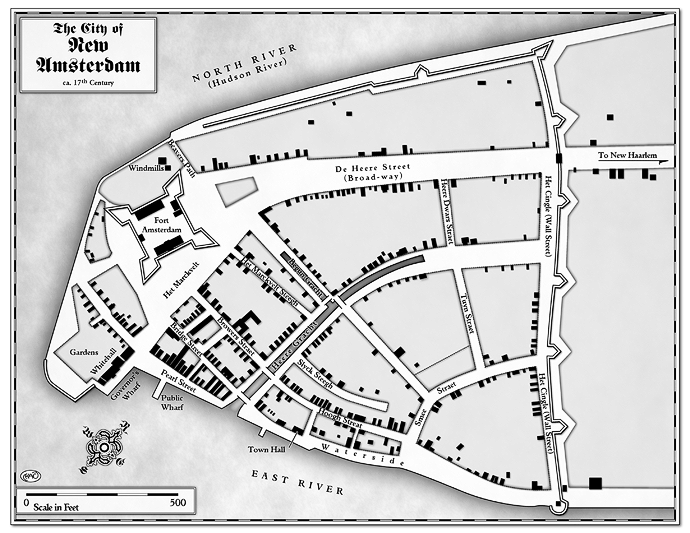
Sort of first governor of New Amsterdam Peter Stuyvesant, Wall street ( Waal straat) (Waal = a river in the Netherlands flowing east to west )

I don't think so. I think that there was an actual wall there, and the fort had personnel and materiel access by what we would call a broad way due to its size - pretty popular city feature, I'm sure you've seen it repeatedly in Europe, yeah?

NewAmsterdam.gif


The name Bronx has Dutch origins, from Jonas Bronck. Same with Harlem. Those are the two well known ones I think.

Other old maps of that time list the area as "Bronck's Farm" or "Bronck's Land." :)
 
I don't think so. I think that there was an actual wall there, and the fort had personnel and materiel access by what we would call a broad way due to its size - pretty popular city feature, I'm sure you've seen it repeatedly in Europe, yeah?

NewAmsterdam.gif


Other old maps of that time list the area as "Bronck's Farm" or "Bronck's Land." :)

Yep, Wall street wasn't Waal straat but in fact it was Het Cingel (De Singel) ( Also a waterish thing :D )

The list of street names :
De Heere Straet (now Broadway)
Het Cingel (now Wallstreet) on the outside of the wall called Nassau st.
The Plein (now Bowling Green)
Heere Gracht (now Broad st.)
Noort Rivier (now north river)
Prince Straet (now Beaver st.)
Begijn Gracht (now Beaver st.)
Paerel Straet (now pearl street)
Het Marckvelt (now whitehall st)
Harlem Meer (from Haarlemmer Meer)
Brugh Straet (now Bridge st.)
Stadt Huys Laan
Fort Amsterdam
Hoogh Straet
Brouwer Straet
Tuyn Straet

More info :

http://www.brooklyn.com/modules.php?name=Street_Names
 
The list of street names :
De Heere Straet (now Broadway) The Lords' Street
Het Cingel (now Wallstreet) on the outside of the wall called Nassau st.
The Plein (now Bowling Green) The Square
Heere Gracht (now Broad st.)
Noort Rivier (now north river)
Prince Straet (now Beaver st.)
Begijn Gracht (now Beaver st.) Beguine street
Paerel Straet (now pearl street)
Het Marckvelt (now whitehall st)
Harlem Meer (from Haarlemmer Meer)
Brugh Straet (now Bridge st.)
Stadt Huys Laan City Hall Lane
Fort Amsterdam
Hoogh Straet High Street
Brouwer Straet Brewer Street
Tuyn Straet Garden Street

I tried to translate some
 
As long as we are on dialects---

BBC News - More men speaking in girls' 'dialect', study shows

What's wrong with you dudes?

"People who speak uptalk are often misunderstood to be insecure, shallow or slightly dim, according to the team, who say this was not necessarily the case.

It grates on people, some people think it sounds really ditzy or insecure. This does not accurately come across like that to the native speakers."


It grates on me. I always tell my students to end their sentences on a low falling terminal. Unless they're asking a question or they're unsure of something, and then a high rising terminal is appropriate. Really to make it clear that they're making a statement or telling you something, rather than asking a question or sounding unsure. Uptalk to me can sound as shallow as "Have a nice day!". But then I'm English, and have never talked that way. :)

George W. Bush started using the high rising terminal more and more during the final couple of years of his term. Which to me gave the impression that he didn't really know what he was talking about.

Mandarin on the other hand is not like this. There's a specific word that's added to a sentence that tells you it's a question. "ma". So for them learning English and how they use terminals can be difficult.
 
You mean like the Canadian EH?

Maybe that's why I didn't care to listen to Dubya. NOOCLEAR drove me nuts.

Doesn't MA have quite a few meanings depending on inflection?

Hearing guys talking like Valley Girls when they aren't stoned would also drive me nuts.

The natives here can't pronounce Pueblo. It's Pee-eblo.
 
You mean like the Canadian EH?

Maybe that's why I didn't care to listen to Dubya. NOOCLEAR drove me nuts.

Doesn't MA have quite a few meanings depending on inflection?

Hearing guys talking like Valley Girls when they aren't stoned would also drive me nuts.

The natives here can't pronounce Pueblo. It's Pee-eblo.

ma 吗 is spoken with the fifth tone(neutral tone) for a question.

mā 妈 mother
m
 
The Vulcan didn't believe me about Chinese being tonal. He was working with a naturalized Chinese national, so I told the Vulcan to ask the gentleman his name in Chinese. The Vulcan said it was like the last 3 notes of the Hungarian Rhapsody.
 
Tell the Vulcan that he needs to know his tones, because if he goes into a restaurant and asks for soup he could end up with sugar, or was he calling his mother a horse?
 
The Vulcan can't even remember the Latin he took in high school. I don't think he remembers any French, either.

Word has a common latin root, he still asks what it means. I guess if it isn't in a schematic, he ignores it.
 
Impression :eek:

Had to be the best impression EVER


I have a certificate somewhere says I speak Mandarin.

It's lying.

Never could get the hang of those 'tones': the teacher would do the ma thing in each tone and I'd be like, you just said the same thing 5 times. At the time I was dating a chinese girl - kinda sad when you can't even pronounce your girl friend's name without calling her who knows what :eek:

Exactly...say if your girlfriend was called "Chǎng", but you said "Chāng", she could very well slap you around. :eek:

娼 chāng = prostitute

IMO the best "teacher" for Mandarin is to go and live in China...LOL. But then half of China doesn't actually speak Mandarin as a first language, there's Cantonese of course plus many different dialects, many of which can only be understood by native speakers. Then there's Mongolian, Tibetan, etc. Think Cantonese is harder than Mandarin because that's got eight tones. Standard Mandarin Chinese (Putonghua) has only been taught in schools since the 1950s I think. Hong Kong has only been teaching Mandarin since about 1997, most people speak Cantonese or English. Macao is worse, because that's effectively quad-lingual now. Cantonese, Portuguese, English and Mandarin.

Possibly as a direct result of the tonal language, a majority of Chinese apparently have perfect pitch - elsewhere, it's pretty rare.

The first tone, long straight, can actually sound like singing. When I've been at the KTV(karaoke room) on the whole they can be quite good singers. Better than what I've heard at a pub karaoke sessions in the UK. :rolleyes:
 
Exactly...say if your girlfriend was called "Chǎng", but you said "Chāng", she could very well slap you around.

娼 chāng = prostitute

Fortunately, she wasn't .. but that could explain some friendship breakdowns :D

The first tone, long straight, can actually sound like singing. When I've been at the KTV(karaoke room) on the whole they can be quite good singers. Better than what I've heard at a pub karaoke sessions in the UK. :rolleyes:

Karaoke should be a war crime

I can forgive the Japanese many things - the rape of Nanking, comfort women, PoW camps - but Karaoke :eek:

That's beyond the pale
 
I have a certificate somewhere says I speak Mandarin.

It's lying.

Never could get the hang of those 'tones': the teacher would do the ma thing in each tone and I'd be like, you just said the same thing 5 times. At the time I was dating a chinese girl - kinda sad when you can't even pronounce your girl friend's name without calling her who knows what :eek:

Cantonese is worse. I didn't realise how difficult the tones were until I took a Mandarin class and they compared the number of tones with these two dialects. I never noticed how difficult it was growing up knowing the language.

Possibly as a direct result of the tonal language, a majority of Chinese apparently have perfect pitch - elsewhere, it's pretty rare.

I never noticed that this was the case.

IMO the best "teacher" for Mandarin is to go and live in China...LOL. But then half of China doesn't actually speak Mandarin as a first language, there's Cantonese of course plus many different dialects, many of which can only be understood by native speakers. Then there's Mongolian, Tibetan, etc. Think Cantonese is harder than Mandarin because that's got eight tones. Standard Mandarin Chinese (Putonghua) has only been taught in schools since the 1950s I think. Hong Kong has only been teaching Mandarin since about 1997, most people speak Cantonese or English. Macao is worse, because that's effectively quad-lingual now. Cantonese, Portuguese, English and Mandarin.

Where I live, Cantonese was the most common Chinese dialect in the 70's and 80's. Now, Mandarin is just as common if not more. I actually grew up learning 3 Chinese dialects. My mother and father (and their sides of the family) each spoke a different dialect. Cantonese was the third dialect that I learned as it was taught in Chinese school and its popularity in my city. I never learned Mandarin. It would have been nice to have learned it, but practically no one used it here while I was growing up. Now, it is very common and should become more popular as more and more immigrants come here from China and Taiwan.
 
I never noticed that this was the case

There's been research - it must be true ;)

Where I live, Cantonese was the most common Chinese dialect in the 70's and 80's. Now, Mandarin is just as common if not more. I actually grew up learning 3 Chinese dialects. My mother and father (and their sides of the family) each spoke a different dialect. Cantonese was the third dialect that I learned as it was taught in Chinese school and its popularity in my city

In Singapore, pretty much all the locals speak a variety of dialects - their folks dialect for home, Mandarin for the formal, Cantonese for enterainment and of course, Hokkien (the most gutteral - Good Morning sounds like a declaration of war) when something needs some really serious expressing :D

There are even odd bits of Malay - in fact, you often get a little bit of everything sledgehammered into a single sentence :D

Also happens with Singlish - actually took me a while to tune in when I first got there. I remember sitting in meetings for like half an hour before I realised everybody was actually speaking English.

Funny things was that the Mandarin course actually helped me understand Singlish: a lot of what I'd thought of as idiosyncracies of Singlish turned out to be word-for-word translations of Mandarin - and where English equivalents don't exist (e.g. ma 吗), they just import them or create something similar, lah.

For some reason, I'm suddenly really missing Singapore - despite it being too darn hot :confused:
 
Back
Top Bottom