

• After 15+ years, we've made a big change: Android Forums is now Early Bird Club. Learn more here.

6

6÷2(1+2) = ?

  • 9

    Votes: 94 54.3%
  • 1

    Votes: 77 44.5%
  • 7

    Votes: 2 1.2%

  • Total voters
    173
seriously? I am by no means a math whiz.. in fact I consider myself somewhat mathematically challenged....In fact I almost doubted myself because it seemed too easy.....
the answer is 9


1+2=3
*always do the equation in parenthesis first
6 divided by 2 =3
*if there is nothing between the two numbers always multiply
3x3=9
so the answer is 9 pieces of bacon!!!LOL
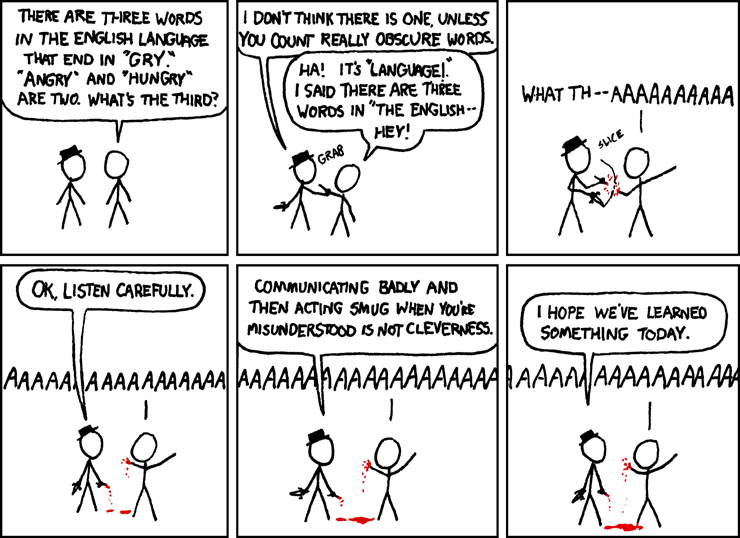
 
The author mentions a word puzzle, but the problem in this thread also applies:

words_that_end_in_gry.png
 
"There are three words in the english language".....

The English Language = three words:)
But you've left out the rest of the sentence, and the rest of the paragraph, therefore your solution doesn't make sense.

Here's what's said:

There are three words in the English language that end in "gry." "Angry" and "hungry" are two. What's the third?

So the statement is that there are "three words in the English language that end in 'gry.'" Not "there are three words in 'the English language.'" And the question being asked refers to the three words that end in "gry"--"Angry" and "hungry" are two. What's the third?

Unless I'm having a major brain fart (and that's ENTIRELY possible!), it just doesn't make sense.
 
I agree!!. It made No logical sense to me either!

I was trying to figure it out and I thought that must be what he meant?
and mehta was confused too so I posted in my two cents:)

I think that's what he meant.. and it makes no sense at all


hmmmm..
 
I believe it has something to do with the original math question allegedly having ambiguity, which is what I think the cartoon makes a reference to. I could be totally wrong as well. :confused:
 
Hey jhawkkw, is answer still same if question was written 6/2(3)?

Yes, the answer is still 9. The parenthesis part of PEMDAS means an operation within parenthesis. Since only the 3 is inside the () and no operation, that step is done. No exponents, so that is skipped. The multiplication is outside the (), and since multiplication and division have equal precedence, you do them in the order they occur from left to right.
 
Thanks. I just have to accept the mathematical convention, but it sure looks funny in my mind's eye, like an optical illusion. I can still see my self mixing up 1/2n as 1/(2n) as opposed to (1/2)n. Good thing I am not an engineer or bridges would be falling down all over the place.
 
Well, I teach math at the college level so I guess that contradicts XplosiV's idea that mathematicians would vote 1. These math question threads that pop up continue to convey the idea that mathematics is something you can opinionate, and is not absolute fact. If I add 3 apples to 5 apples, you get 8. Not 2, not 10, but 8. The laws of mathematics are absolute and breaking them results in contradictions. An example is one of the many division by zero fallacies. I'll show this one as an example:

let a=b,
by multiplying both sides by a, you would get a^2 = ab.
subtract b^2 from both sides yields a^2-b^2 = ab - b^2.
factoring using the difference of squares on the left side, and the common factor of b on the right side yields (a+b)(a-b)=b(a-b).
dividing (a-b) on both sides yields a+b = b.
since a=b, making the substitution yields b+b or 2b = b.
finally, dividing both sides by b yields a final result of 2=1, which is clearly not correct. This is because of the division of (a-b) because that is equal to zero. Division by 0 isn't allowed under standard mathematical arithmetic, which causes the contradiction of 2=1.

6
 
I do follow that but I guess I agree with XplosiV because I studied electronic engineering at uni (a long time ago) and my maths is ok but I did see the 2(2+1) as having operational priority, placing the product in the denominator. I guess I didn't read it as a computer algorithm would interpret it but tackled the parenthesis and its immediate product first. I'm not claiming I'm right, just that the presentation of the problem invites alternative interpretations due to ambiguity.

I like this thread.

Indeed. There is no doubt that because of the way one types(all on one line), versus hand writes, there is inherent ambiguity. Maybe the author of this thread intended it to be that way to cause the debate, maybe not. It certainly has spurred some. :)
 
Indeed. There is no doubt that because of the way one types(all on one line), versus hand writes, there is inherent ambiguity. Maybe the author of this thread intended it to be that way to cause the debate, maybe not. It certainly has spurred some. :)

It certainly has. :)

I read through the whole thread and I don't know how it got reprized but I'm glad it did and I can see it continuing for a good while.

It took me a long while to reconcile myself to the probability that I might have chosen the wrong answer. Lots of hedging there; I still can't accept it completely :)
 
I do follow that but I guess I agree with XplosiV because I studied electronic engineering at uni (a long time ago) and my maths is ok but I did see the 2(2+1) as having operational priority, placing the product in the denominator. I guess I didn't read it as a computer algorithm would interpret it but tackled the parenthesis and its immediate product first. I'm not claiming I'm right, just that the presentation of the problem invites alternative interpretations due to ambiguity.
But, as I see it, there is no ambiguity. There's only PERCEIVED ambiguity by people who don't understand how math problems are supposed to be solved! :D
 
But, as I see it, there is no ambiguity. There's only PERCEIVED ambiguity by people who don't understand how math problems are supposed to be solved! :D

Or there's only perceived ambiguity by people who do understand how maths problems are supposed to be written? ;)

As jhawkkw, who teaches maths at college level, says in his post above:

There is no doubt that because of the way one types(all on one line), versus hand writes, there is inherent ambiguity.

The ambiguity is caused because maths problems are not usually written in one typed line as the OP provided. That is more akin to a line of computer code, and the way a computer interprets a line of code is not the same as the way a hand written maths equation is usually solved. But to complicate matters, a line of code would not usually have the 2 immediately in front of the parenthesis without an asterisk * to indicate multiplication. The problem 6
 
there is no relativity in math. it is constant and predictable..the answer is 9
there is no other correct answer or interpretation
it is exactly the same as 1+1=2
2 is ..and always will be... the only outcome...
the original equation is not written ambiguously it is the standard in mathematics
I think the point of the whole thing is to draw attention to the fact that a simple middle school math problem is difficult and confusing for many and it shouldn't be..so it's a fail on the state of math and education.... ...those dern kids...get off my lawn :) !


.
 
yikes!! I was just coming back on to say I think thatI may have sounded all stiff and snooty and maybe even a little b:) I didnt mean it that way..:) in fact I don't even like math!!
 
Back
Top Bottom