Looks can be deceiving, an engineering friend of mine did this as a study during college. The math is absolutely workable without compromising hull integrity (that's on about 85% of modern aircraft).
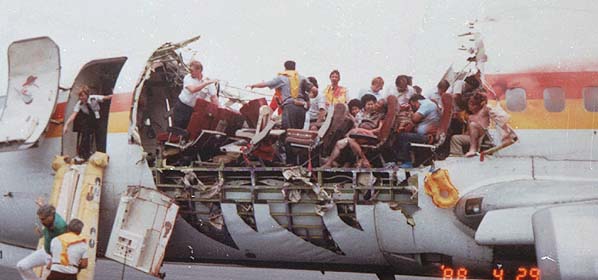
Here's an image of a Boeing 737. This plane has had the top sheered off due to an accident so you can see just how much space is below the seating area. and how much space is above. The seating area probably takes up 60-70% of the height of the plane.
Now, not all of that space is cargo space. That's where your assumption that you can convert all that space to passenger space fails. In that space is the guts of the airplane - electrical wiring, plumbing, engine parts, etc..... The cargo area isn't that big of a section of the plane. I tried to look up pics and somehow came back with porn. No clue how that happened. Even if you could convert the cargo area into passenger space, like EarlyMon said you still have to add flight crew accommodations, lavatories, additional serving areas, overhead storage for carry on luggage, etc...... By the time you add all of that, you're going to have a very, very cramped cabin with very few seats.
I guess we'll have to inform Fedex that what they are doing is a logistical nightmare where it is cheaper to fly than to ship packages... but then, they will probably just look at you and laugh.
You're missing the point of the logistics. If you Fedex a package and you send it two day mail, it has to get on the plane today. When today doesn't matter. The package getting on the plane this morning, this afternoon or this evening doesn't really matter. Shipping luggage is a completely different thing.
Let's say I take the NY to Philly flight. I check luggage. Under the current system, there's no problem. They tag the luggage so they know what plane it goes on and they toss it on the plane I'm taking. Luggage gets to Philly the moment I do. The only wait for me is the time it takes to unload the luggage and toss it on the conveyor.
Under the new system there are issues. They now have to have two flights that leave for Philly at about the same time. They have to tag the luggage appropriately and somehow have to sort out how to tell the cargo plane from the passenger plane. They would have to coordinate two planes taking off for Philly and landing in Philly at about the same time. The cargo plane can't leave until the passenger plane has left. You're not going to fly baggage when you don't have a passenger to go with it. That's how it's currently done and I don't see why that would change. Routing is going to be a PITA. Both planes have to get there at the same time. If the passenger plane lands, but there's no room for the baggage plane to land, passengers are going to be ticked as they sit at baggage claim and watch their baggage circle overhead.
What do you do if the baggage plane takes off with no issues, but the passenger plane breaks down? Now you're sitting in NY, but your luggage is on the way to Philly. Ain't that lovely. Does the airline just sit on your luggage in Philly and wait to see if you can get another flight out of NY? What if you decide that if you can't get to Philly that day, your business trip is wasted so you want to cancel it? Now the airline has to find just your bag out of all those bags and fly it back to NY. Will you wait a few hours for this to happen? How ticked are you going to be? What if it's the other way around? What if the passenger plane makes it, but the luggage plane has to make an emergency landing somewhere? Now you're in Philly, but your luggage is in Buffalo. And it's not just you, it's 200 people on your flight in the same boat. That's not a nightmare for an airline company. It's a logistical nightmare.
Airlines are desperate for revenue right now. If your plan makes so much sense and would increase their profits so much, why are none of them considering it?