

Rominucka
Well-Known Member
The bars on your phone are there to make you feel better. They are nowhere near accurate in telling you that you have good signal.
4 out of 5 bars with a signal strength of -85dbm is retar*ed. On a 5 bar scale -85 should be 2 bars at the MOST!
At -96dbm the receiver will barely be able to decipher the signal from the noise floor. It's like listening to an extremely staticy radio station where you THINK you hear music.
At -85dbm you could at least tell what genre the music is and maybe the artist.
At -70dbm, the static is loud and annoying but you can clearly tell what song it is.
At -60dbm, the static is there but you only hear it during the quite parts of the song. This is considered good (not great) signal strength for OTA broadcasting.
Anything below -70dbm and the phone's receiver tuning function is working overtime to filter out the noise and lock onto the 700MHz.
700MHz is good because unlike WiMax (2+GHz, which gets destroyed by the likes of simple fog in the air) it has no trouble penetrating, not only fog but building structures. In fact 700MHz can be knocked around a little by the likes of clouds all the way up to the density of buildings in a favorable way.
It's raining where I am tonight and I noticed that I was getting 4G in an area of my house that never gets 4G. I drove to the store which is about a half mile closer to Verizon's towers and while waiting at a red light I checked my signal strength, and this is what I got.....
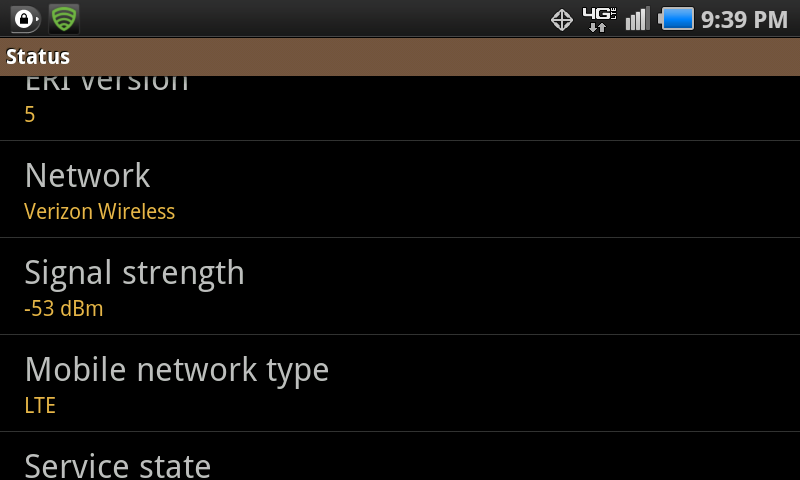
WOW!!! I could be wrong, but I believe the super-thick cloudy sky was causing any stray signal to bounce back, boosting the ground reception. I never get signal that strong, even when I clocking in with 12+Mbps downlink....which brings me to this:
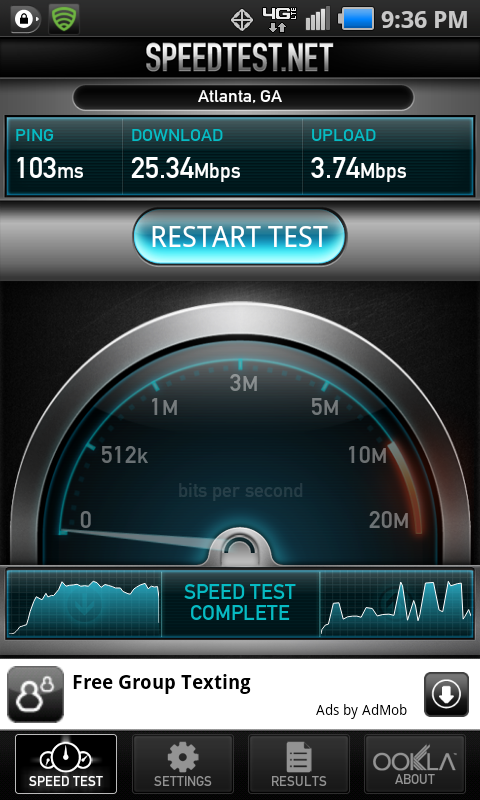
This is the highest Mbps downlink I've gotten so far, and I'm a good 10 or so miles away from the towers. This was actually taken before I took the signal strength shot. I was next to the supermarket and only reading -70dbm at this point. The -53dbm was on the road at the intersection...less structural interference.
So anyway, that's it for now. I'm gonna do some more basic studying on the function of frequency broadcasting. No more guessing and half baked, 3rd party information relay. I know a guy who can help teach me more. He's been the senior technician for the past 10 years for the CBS transmitter at the top of the Empire State Building...I call him Dad.
4 out of 5 bars with a signal strength of -85dbm is retar*ed. On a 5 bar scale -85 should be 2 bars at the MOST!
At -96dbm the receiver will barely be able to decipher the signal from the noise floor. It's like listening to an extremely staticy radio station where you THINK you hear music.
At -85dbm you could at least tell what genre the music is and maybe the artist.
At -70dbm, the static is loud and annoying but you can clearly tell what song it is.
At -60dbm, the static is there but you only hear it during the quite parts of the song. This is considered good (not great) signal strength for OTA broadcasting.
Anything below -70dbm and the phone's receiver tuning function is working overtime to filter out the noise and lock onto the 700MHz.
700MHz is good because unlike WiMax (2+GHz, which gets destroyed by the likes of simple fog in the air) it has no trouble penetrating, not only fog but building structures. In fact 700MHz can be knocked around a little by the likes of clouds all the way up to the density of buildings in a favorable way.
It's raining where I am tonight and I noticed that I was getting 4G in an area of my house that never gets 4G. I drove to the store which is about a half mile closer to Verizon's towers and while waiting at a red light I checked my signal strength, and this is what I got.....
WOW!!! I could be wrong, but I believe the super-thick cloudy sky was causing any stray signal to bounce back, boosting the ground reception. I never get signal that strong, even when I clocking in with 12+Mbps downlink....which brings me to this:
This is the highest Mbps downlink I've gotten so far, and I'm a good 10 or so miles away from the towers. This was actually taken before I took the signal strength shot. I was next to the supermarket and only reading -70dbm at this point. The -53dbm was on the road at the intersection...less structural interference.
So anyway, that's it for now. I'm gonna do some more basic studying on the function of frequency broadcasting. No more guessing and half baked, 3rd party information relay. I know a guy who can help teach me more. He's been the senior technician for the past 10 years for the CBS transmitter at the top of the Empire State Building...I call him Dad.

