
• After 15+ years, we've made a big change: Android Forums is now Early Bird Club. Learn more here.

Root throwing in the towel

For all of you that have followed this thread, s-off has finally been archived . The problem was with my computer. Linux wouldn't install alongside Windows and run correctly. Ended up installing only Linux and it worked for me. I will re-install Windows at a later date. Thanks for all the support and encouragement

Unless you play games, there isn't any reason you ever need Windows again.

Congrats on s-off.
 
For all of you that have followed this thread, s-off has finally been archived . The problem was with my computer. Linux wouldn't install alongside Windows and run correctly. Ended up installing only Linux and it worked for me. I will re-install Windows at a later date. Thanks for all the support and encouragement
If you ever need help with Linux, I can help you. The reason you couldn't dual-boot is because you didn't resize your Windows partition to make room for your Linux partition to be created. It takes less than 2 minutes to do that, so next time you have a problem, speak up & get some help.
 
Unless you play games, there isn't any reason you ever need Windows again.

Congrats on s-off.
I've been using Linux exclusively for more than a decade, and I've got to disagree with you here...

There are some proprietary applications available for Windows that simply do not run, or run poorly, in Linux. The alternatives available are not always acceptable.

For example, Adobe Illustrator - Inkscape is a joke of a replacement. ArcGIS - GRASS and QGIS are not there yet. Microsoft Office - LibreOffice and OpenOffice are nowhere near as good.

There are plenty of professional-level applications that don't run as well on Linux. Virtualization is not always an option, as resources are not fully utilized in a virtual environment. As much as it pains me to say, Windows is necessary sometimes.
 
I have the old version of control bear that works with Windows 7 or below . I use it on a 64 bit machine. I'm moving today. But I can upload it later tonight. I just used it last week on my friends EVO.. All you have to do is load harmonia. Then run it and do the wire trick. PLEASE DONT GIVE UP. Give me a few hours I will post a link here.
 
For all of you that have followed this thread, s-off has finally been archived . The problem was with my computer. Linux wouldn't install alongside Windows and run correctly. Ended up installing only Linux and it worked for me. I will re-install Windows at a later date. Thanks for all the support and encouragement

YAY! Congratz......I've been following this thread, couldn't really offer any help cause im a newbie myself and never used the Linux guide but welcome to the world of s-off enjoy :)
 
MacOS=BSD

Similar to Linux, but definitely not Linux.
This will be the last I say on this topic, because arguing about it is pointless here, but...

MacOS is not BSD in the true sense. It uses code from BSD in its kernel and for POSIX compliance purposes, but it is so heavily modified at this point that to call it BSD in the same way you'd call OpenBSD, FreeBSD, or NetBSD is inappropriate. Behind the scenes, Apple's OS is has very little in common with BSD. In userland, there are some very noticeable similarities.

Suffice it to say, while there is a shared code base between OS X and *BSD (particularly FreeBSD), they are nowhere near the same thing (!=).
 
Having been in touch with the OS X developers before it went public, and having used it for as long, I'll help -

When launched, it was accurately advertised as a fusion of NetBSD, OpenBSD and FreeBSD. That's the basis of its services.

It has never used the BSD kernel.

It's an extended Mach kernel (with embedded copyrights to prove it) and is more properly known as the XNU kernel.

I've done a lot of Mach kernel development. Pretty sure I know one when I see one.

There is more than ample evidence of everything I've stated beginning with the original Darwin repository.

Hope this clarifies any confusion, cheers! :)
 
When launched, it was accurately advertised as a fusion of NetBSD, OpenBSD and FreeBSD. That's the basis of its services.
Wasn't it actually a reincarnation of NeXTSTEP? My understanding is that when Steve Jobs returned to Apple from Next he pretty much brought what was to become Mac OS with him.

ramjet73
 
There was a lot of NeXT in OS X, definitely.

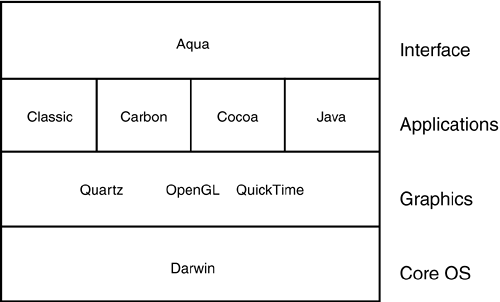
01fig01.gif


The kernel and BSD components are down at Darwin, NeXT far above that.
 
There was a lot of NeXT in OS X, definitely.

The kernel and BSD components are down at Darwin, NeXT far above that.
My understanding is that there is a lot of NeXT at the kernel and OS level too. Here's a quote from the Wikipedia article I linked in my last post:

NeXT changed its business plan in mid-1986. The company decided to develop both computer hardware and software, instead of just a low-end workstation. A team led by Avie Tevanian, who had joined the company after working as one of the Mach kernel engineers at Carnegie Mellon University, was to develop the NeXTSTEP operating system.

Here's another quote from later in that article:

Apple Computer announced an intention to acquire NeXT on December 20, 1996.[3] Apple paid $429 million in cash which went to the initial investors and 1.5 million Apple shares which went to Steve Jobs. (Steve Jobs was deliberately not given cash for his part in the deal.)[3][49] The main purpose of the acquisition was to use NeXTSTEP as a foundation to replace the dated Mac OS instead of BeOS or the in-development Copland.

I'm sure the credit got very grey once Jobs rejoined Apple but my recollection is that most of the innovation in Mac OS today came from NeXT, even though the Mac interface was ported on top of everything else.

ramjet73
 
A lot of this really digs back to the time when the microkernel architecture started gaining momentum. Mach was best known for that, and I was exposed to its dark underbelly. Much of what came out of CMU was not all peaches and cream despite the press of the day.

There were a few projects at Apple evaluating different os architectures back then, and the NeXT influence was quite strong (Cocoa was a sdk renaming). The ties to the Darwin and NeXT are pervasive but there's quite a bit of original development and BSD there.
 
Back
Top Bottom